Soup

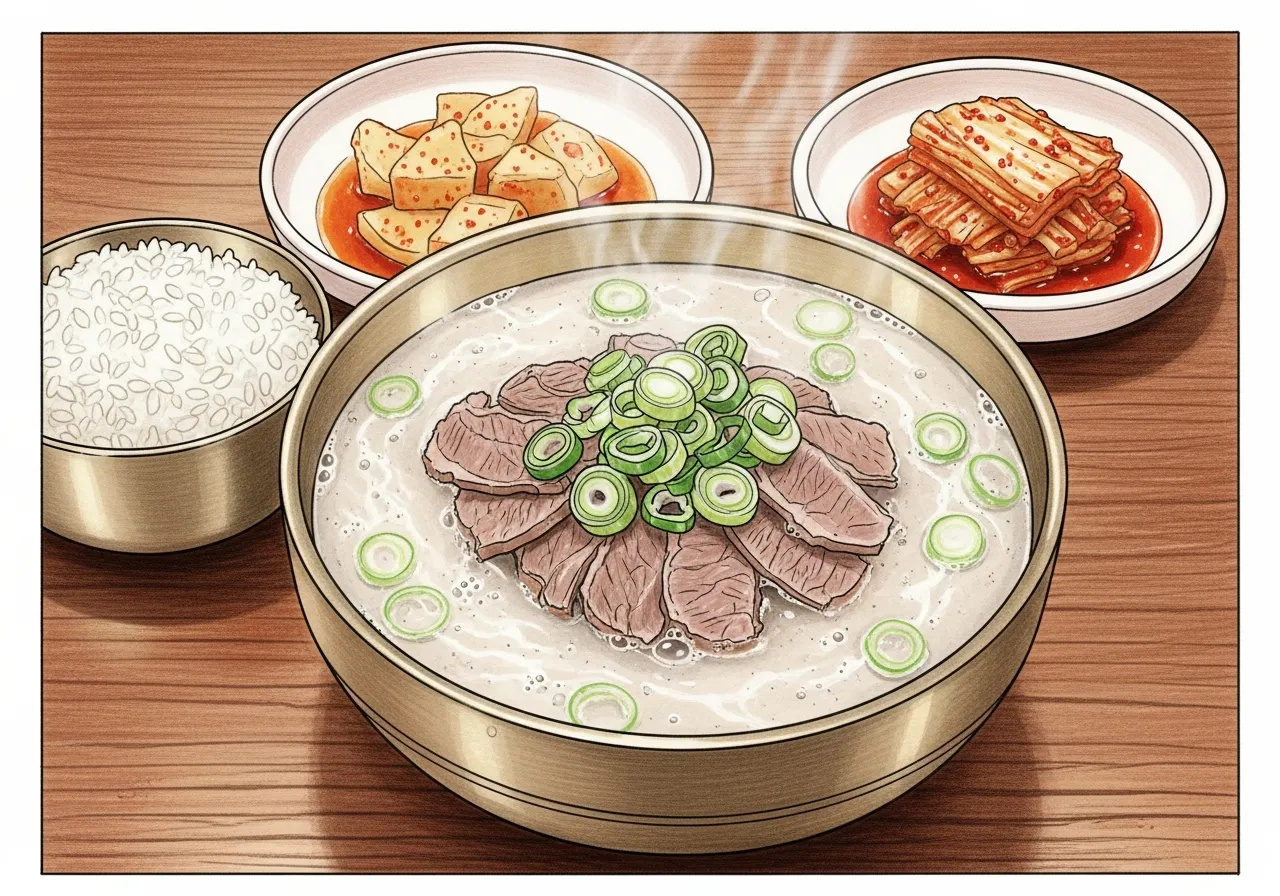
Seolleongtang (Korean Ox-Bone Soup)

Ox bones simmer with brisket and daikon into a milky broth; this small home batch needs about 8 hours of gentle cooking.

Total 520 min Large heavy-bottomed soup pot Advanced 6 servings 380 kcal
Large heavy-bottomed soup potFine-mesh strainerFood thermometerSoup bowls High-protein meals
Seolleongtang (Korean Ox-Bone Soup)

This small home batch slowly simmers ox leg bones with brisket and daikon. Remove the tender beef and radish first while the bones continue cooking until the broth turns milky; season each bowl at the table.

  • Recipe source: Maangchi — Ox-bone soup (Seolleongtang) Adapted from blanching and rinsing bones, simmering to a milky broth, and removing beef and radish early, scaled for a smaller home batch.
  • Food safety guidance: Bacteria and Viruses Official FoodSafety.gov guidance: refrigerate perishable foods within 2 hours; the recipe adds item-specific storage or reheating cues.
  • Food safety guidance: USDA FSIS — Leftovers and Food Safety Official guidance to cool large pots of soup in shallow containers, bring soups to a boil when reheating, and heat leftovers to 74°C / 165°F.

Steps

How to make it

Prep 30 min · Cook 490 min

  1. Soak the bones in cold water for 30 minutes, changing the water once. Cut the brisket into large pieces, peel and cut the daikon, and peel the onion.
  2. Cover the 1.5 kg ox leg bones with cold water in a large pot and boil for 10 minutes. Discard that blanching water, rinse the bones under cold water, and wash the pot to remove bone fragments and scum.
  3. Return the rinsed ox leg bones to the pot with 4 L initial water, brisket, daikon, and onion. Bring to a boil, skim the surface, then lower the heat to a steady gentle simmer.
  4. From the point the pot settles into a simmer, cook for about 2–2½ hours, or until a fork slides through the brisket but the meat still holds together for slicing, and the daikon looks slightly translucent and is easily pierced without falling apart. Remove the beef and radish. Portion the sliced meat and radish into shallow containers and refrigerate within 2 hours; do not wait for the whole pot to cool. Count about 8 hours of total bone cooking from the start of the simmer, including the first 2–2½ hours with the brisket and daikon. If the water drops below the bones, add hot water in stages just to cover them again.
  5. Strain the broth into several shallow containers while hot so it cools quickly; refrigerate within 2 hours rather than waiting for it to reach room temperature. To serve, bring only the needed broth to a rolling boil, add portions of beef and radish, and use a food thermometer to confirm the toppings reach 74°C / 165°F. Finish with scallion, salt, and black pepper at the table.
Tips & storage

Make it easier

  • Keep the broth at a steady gentle simmer; a hard boil evaporates water too quickly. If the bones become exposed, add only enough hot water to cover them again instead of restoring the pot to its initial 4 L mark. Final broth volume varies with the pot and evaporation.
  • For a large batch, refrigerate the broth, beef, and radish in separate shallow containers; do not leave the stockpot to cool on the counter.

Divide broth, beef, and radish into shallow containers and refrigerate at 4°C / 40°F or below within 2 hours; use within 3 days or freeze. Reheat broth and toppings to at least 74°C / 165°F.

FAQ

Why blanch the bones first?

Boiling briefly, discarding the water, and rinsing removes some scum and bone fragments before the long simmer.

Does it need the full 8 hours?

A long, gentle simmer helps create the characteristic milky broth. Pots and burners vary, so allow longer if needed and use the broth appearance and bones as cues. The final amount of stock also varies with evaporation and has not been measured for this batch.